"It is imperative that the Black Church not allow our 27.7 million members or the Black community to fall permanently behind in this new once-in-a-lifetime change in monetary policy. We must think with our heads and not with our cultural emotions despite the current political environment. We must understand that the goal here is not to seek equality or equity but to become leaders in this new monetary movement.
Therefore, we must stop listening to those who see this as one-dimensional or from their narrow perspective. We must take this opportunity and show the world our unique cultural creativity that our ancestors Musa and the Kush empire taught us. We have a rare opportunity as a community to move forward and provide leadership, stop running from behind, and turn black economics on its head for the first time. The Black Church intends to utilize its broad powers and authority to make sure that forward-thinking African Americans have the best chance to become leaders in partnership with others industry leaders in this new monetary movement."
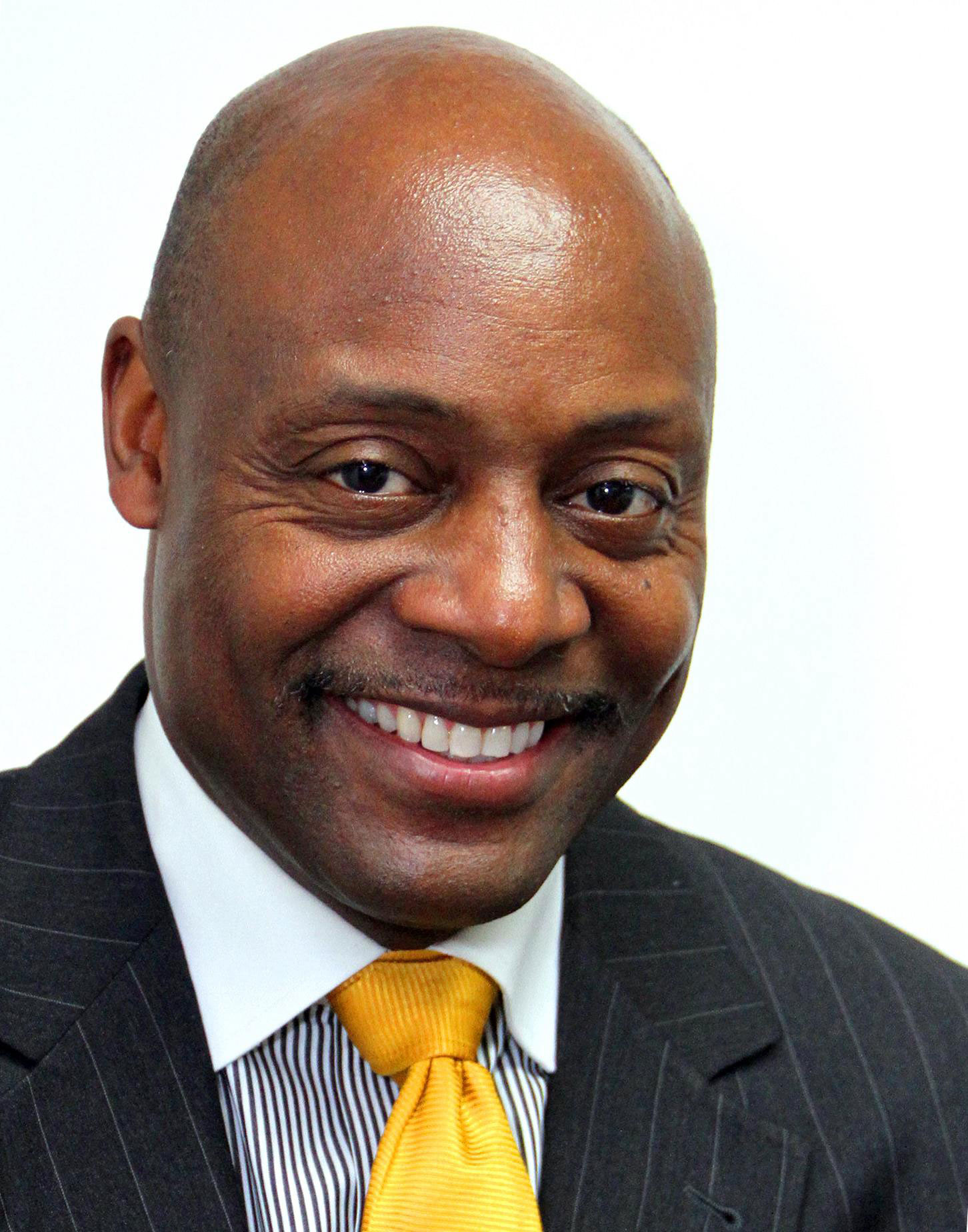
Rev. Anthony Evans
NBCI President
In 2027, NBCI will start monthly Crypto currency Zoom seminars with special guests to talk about different aspects of the crypto industry.
- We will launch an online crypto course for all 27.7 million members. It will be a free course explaining the ABCs of cryptocurrency and how to incorporate it in your investment or financial lifestyle.
- NBCI will conduct a seven-city town hall on cryptocurrency and the African American community in Los Angeles, Atlanta, Chicago, Miami, Boston, New York, and Houston with the U.S. Federal Reserve.
- NBCI will distribute an online cryptocurrency "Survival Guide Directory" on the NBCI Digital Divide Initiative (www.naltblackchurch.com/technology/). This guide will list all the major players and companies in crypto.
- NBCI has launched a hundred-post social media campaign, and it will continue to post important information around cryptocurrencies.
- NBCI will launch a cryptocurrency YouTube channel in 2027.
- NBCI, working with the cryptocurrency leaders and partners will create an online guide on how to purchase cryptocurrencies.
Why Is NBCI Concerned About the Cryptocurrency Bill?
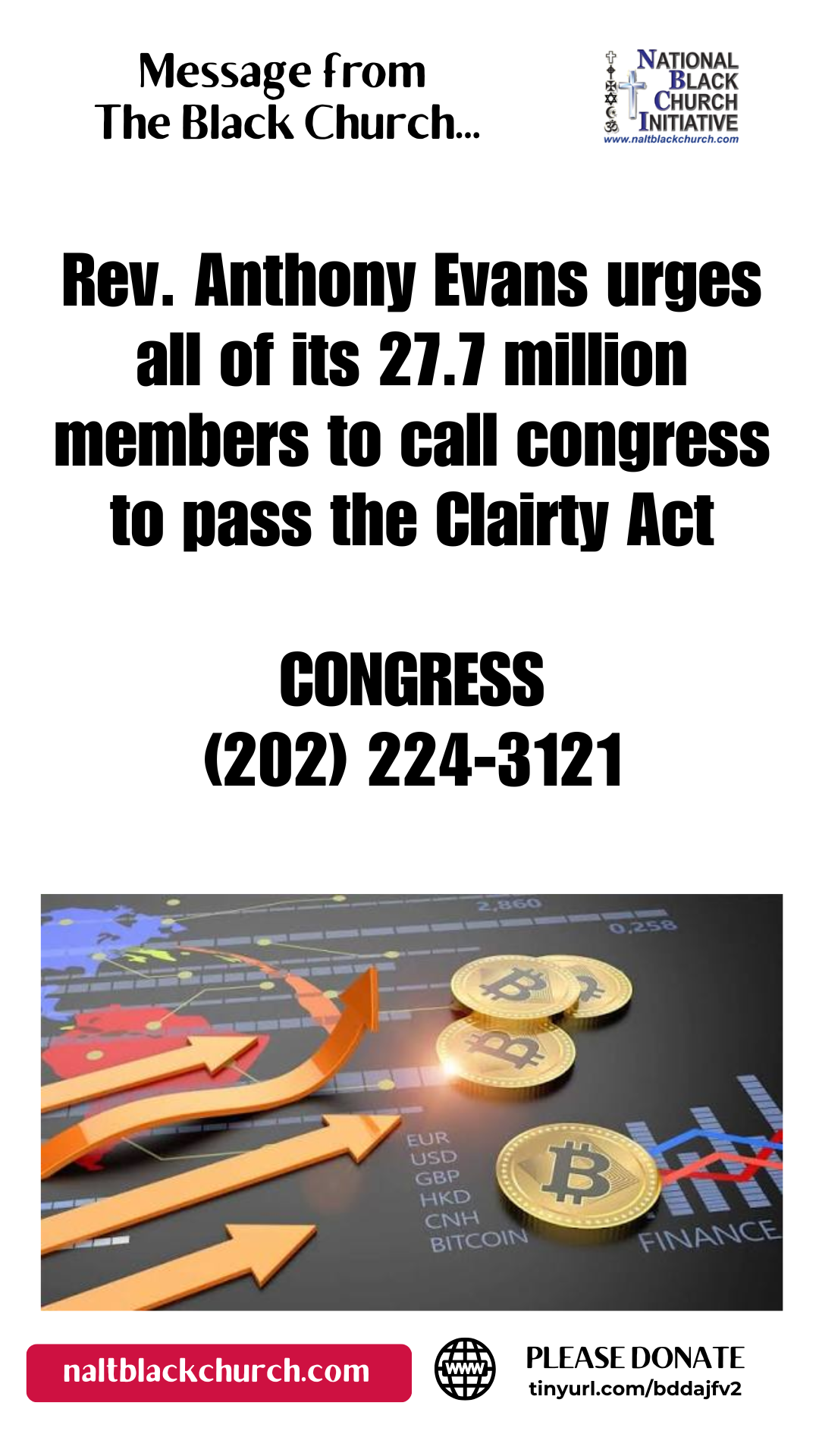
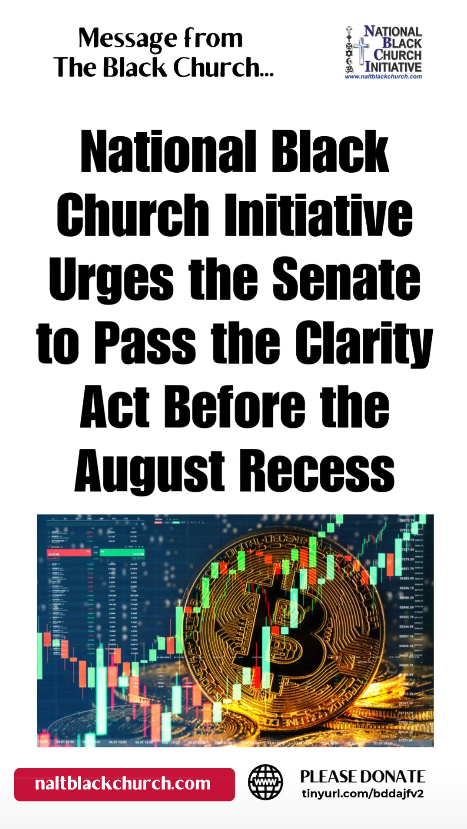
WASHINGTON, DC, UNITED STATES, July 24, 2026 /EINPresswire.com/ -- The National Black Church Initiative (NBCI), a coalition of 150,000 African American and Latino faith communities comprising 27.7 million members, is calling on the United States Senate to pass the Clarity Act before the August
recess. NBCI has sent a letter to Senate Majority Leader John Thune and Senate Minority Leader Charles Schumer urging immediate action.
NBCI supports this bill for two reasons: consumer protection and economic opportunity. African American families are losing money to digital asset frauds, while the absence of clear federal rules leaves consumers uncertain about where to turn when they are defrauded. Without a clear regulator responsible for oversight and enforcement, bad actors can exploit gaps in the law and target communities that have historically had less access to trusted financial services.
At the same time, digital assets can expand economic opportunity for African Americans by lowering barriers to financial services, supporting entrepreneurship, enabling
new forms of ownership and investment, and creating pathways into a growing technology sector. Congress should establish clear rules that protect consumers from
fraud while allowing responsible innovation to serve communities that have too often been excluded from the traditional financial system.
Rev. Anthony Evans, President of NBCI, said, "The Black Church cannot afford to be late to the future of finance, and we cannot allow our people to enter that future unprotected. Regulatory uncertainty does not protect anybody but the wrongdoer. Congress has known this for
years. It’s time to pass Clarity."
The Clarity Act would establish federal oversight of digital asset markets, require companies to keep customer assets protected rather than commingled or misused, set consistent standards and disclosure requirements, and give regulators and law enforcement clear authority to pursue misconduct.
Rev. Evans continued, "Our churches are where families come after the money is gone. We sat with them. We prayed with them. We are tired of cleaning up after a system that Congress refuses to fix. The measure of this law will not be the capital it attracts. It will be the families it keeps whole."
NBCI is also calling on federal regulators to work directly with Black churches as the law is implemented. The Black Church has the trust, the reach, and the moral standing to teach 27.7 million members how to protect themselves, recognize fraud, and make sound financial decisions. No government agency has that reach.
Rev. Evans said, "We have spent too many generations entering new economic systems after the wealth has already been handed out. That will not happen again. Give us the rules, give us a seat at the table, and the Black Church will do the rest."
NBCI urges the Senate to act before the August recess.
AARP
arp.org
601 E Street NW
Washington, DC 20049
Andreessen Horowitz (a16z Crypto)
a16z.com
2865 Sand Hill Road, Suite 101
Menlo Park, CA 94025
Blockchain Association
theblockchainassociation.org
1701 Rhode Island Ave. NW
Washington, DC 20036
Brownstein Hyatt Farber Schreck LLP
bhfs.com
600 Massachusetts Ave. NW, Suite 400
Washington, DC 20001 (lda.gov)
Chainalysis
Chainalysis.com
114 Fifth Avenue, 18th Floor
New York, NY 10011
Circle Internet Group
circle.com
99 High Street, 27th Floor
Boston, MA 02110
Consensys
consensys.net
49 Bogart Street, Suite 22
Brooklyn, NY 11206
Consumer Technology Association
cta.tech
1919 S. Eads Street
Arlington, VA 22202
Fidelity Investments
go.fidelity.com/LIterms
245 Summer Street
Boston MA 02210
Jito Labs
jito.wtf
2261 Market Street #86488
San Francisco, CA 94114
Kraken
kraken.com
237 Kearny Street #102
San Francisco, CA 94108
Nielsen Merksamer, LLP/Coinbase
nmgovlaw.com
2350 Kerner Blvd., Suite 250
San Rafael, CA 94901
Project Liberty Institute
projectliberty.io
501 W 30th St Fl 37
New York City NY 10001
Ripple
ripple.com
315 Montgomery Street, 2nd Floor
San Francisco, CA 94104
Solana Policy Institute
solanapolicyinstitute.org
1025 Thomas Jefferson St. NW Suite 400
West Washington, DC 20007
The Digital Chamber
digitalchamber.org
1667 K Street NW, Suite 640
Washington, DC 20006
The Firm Consulting LLC (Coinbase state registration)
thefirmllc.net
313 North Plankinton Avenue, Suite 210
Milwaukee WI 53203
White House / Craft Ventures
craftventures.com
One Letterman Dr., Bldg. D, Suite 4100
San Francisco, CA 94129
Why it is important to regulate the Crypto industry?
With 2018's crypto winter finally firmly in the rearview mirror, the crypto industry's
next big challenge reared its head early in 2019: Regulation.
After several barks at virtual asset transgressors in recent years, the Financial Action
Task Force (FATF) finally delivered its first bite in February 2019- and it was a big
one. FATF's Interpretive Note to Recommendation 15 paragraph 7(b)-R16 introduced
what many expected was inevitable- the so-called "Crypto Travel Rule" that will force
exchanges to share the real-world identity of customers with each other to help
support Anti-Money-Laundering (AML) and Combating Funding of Terrorism (CFT )
activities. T his followed increasing regulatory clarification and prosecutions by the U.S
AML/CFT watchdog FinCEN.
Follow this link and read the entire article...
Surveys show that Black consumers are more likely than white consumers to own cryptocurrencies. A 2021 Pew Research Center survey of U.S. consumers, for example, found that 18 percent of Black adults had invested in, traded, or used a cryptocurrency compared with 13 percent of white adults. This difference between Black and white consumers' cryptocurrency ownership contrasts sharply with other traditional assets. For example, according to the Board of Governors of the Federal Reserve System's 2019 Survey of Consumer Finances (SCF), 61 percent of white households owned equity investments compared with 34 percent of Black households-a nearly two-to-one margin.
Unlike white consumers, Black consumers are in fact more likely to own cryptocurrencies than assets such as stocks and mutual funds. Chart 1 suggests that Black consumers have a higher ownership rate for cryptocurrency
than for stocks and mutual funds.
African Americans in Crypto
By: Lauren Pearlman, PhD
For generations, Black Americans have been locked out of wealth-building opportunities by discriminatory housing, lending, and labor policies. While policymakers have worked to address the racial wealth gap, Black communities still have lower rates of homeownership and less retirement savings than their white peers. Today, as new technologies reshape our financial system, cryptocurrency has emerged as a beacon of possibility. About
one in four Black Americans now own cryptocurrency, with younger generations especially drawn to its promise of bypassing traditional financial gatekeepers. For many who have experienced housing discrimination, loan denials, and biased banking practices, the appeal of a decentralized, user-driven system is clear: a chance to build wealth without asking permission from institutions that have too often said “no.”
Yet this optimism exists alongside real risks. Cryptocurrency operates outside the safety nets of consumer protections, insurance, or federal oversight. When the popular cryptocurrency company FTX infamously collapsed in 2022, customers, including Black investors, lost their funding with no recourse. With celebrities, entrepreneurs, and even a sitting president promoting digital assets, the stakes are higher than ever. Without stronger guardrails, the very communities seeking financial empowerment may end up bearing the heaviest losses. Federal policy is lagging behind this fast-moving frontier. There is even disagreement among agencies as to whether crypto is a commodity, a security, or something else entirely. This lack of clarity makes meaningful regulation difficult, and it leaves families vulnerable to scams and market volatility. Meanwhile, federal resources that once helped Black entrepreneurs, like the Minority Business Development Agency,
have been gutted. Instead of giving Black communities more tools to build sustainable wealth, this administration is leaving them to navigate the Wild West of digital finance alone.
The path forward requires both protection and possibility. Congress should adopt a uniform definition of cryptocurrency, enact stronger laws against blockchain-enabled fraud, and require major crypto firms to insure consumer assets. Equally important, we need public investment in financial literacy and resources that empower Black Americans to make informed choices about where to put their money. Innovation does not have to come at the expense of equity. Cryptocurrency will not close the racial wealth gap on its own. But if paired with bold policies that strengthen fair housing, expand access to capital, and ensure consumer protections, it can be one tool among many to build a more equitable economy. The question is whether politicians will let new technologies replicate the old inequities or whether they will seize the chance to chart a different future.
That’s the conversation we are taking up at the 2025 Policy for the People Economic Advancement Virtual Summit hosted by the Congressional Black Caucus Foundation. In our final session, we will explore the policies that can unlock Black prosperity, from tax reform to homeownership to entrepreneurship in a digital age.
Join us on October 30 to be part of this urgent dialogue. Register today and help us build the future Black America deserves.
by LE Pantin · 2023 · Columbia Law School Scholarship Archive
As a community, Black people consistently face barriers to
full participation in traditional financial markets. The decentralized nature
of the cryptocurrency market is attractive to a community that has been
historically and systematically excluded from the traditional financial
markets by both private and public actors.
As new entrants to any type of
financial market, Black people have increasingly embraced blockchain
technology and cryptocurrency as a path towards the wealth-building
opportunities and financial freedom they have been denied in traditional
markets.
This Article analyzes whether the technology’s decentralized
system will lead to financial inclusion or increased financial exclusion.
Joint Center Quoted in The American Prospect on Crypto Impacting Black Americans
Jun 18, 2026 — Joint Center Senior Researcher Cantrell Dumas was quoted in The American Prospect in an article discussing corporate money shaping primary elections and influencing upcoming crypto regulation in Congress. Dumas discusses how cryptocurrency is not an ideal avenue for Black Americans.
From the article: “But crypto isn’t exactly an ideal avenue to ensure financial inclusion for Black Americans. ‘Crypto’s appeal is understandable because many Black households have faced exclusion, discrimination in the traditional financial space, but crypto does not solve those underlying issues,’ says Cantrell Dumas, senior researcher for financial regulation and policy at the Joint Center for Political and Economic Studies. ‘Crypto is extremely volatile and speculative, and it matters because Black households on average have less inherited wealth, fewer liquid savings, and less margin to absorb those losses. A risky asset like crypto or Bitcoin can deepen that inequality.'”


Apr 20, 2022 — Luminaries like Spike Lee have promoted crypto as a way for Black families to grow their wealth. Yahoo Finance proclaims that “Black Americans are leading the crypto revolution,” while the Washington Post says “more people of color are turning to cryptocurrency.”
A University of Chicago poll suggests that nearly 44 percent of the Americans who own crypto are people of color. Many stories also mention a Harris poll claiming that 23 percent of all African Americans have invested in crypto.
Those are impressive figures, but they may overstate the case. A Morning Consult poll found that a modest 8 percent of crypto owners are African American. And even for most of them, the numbers don’t seem to add up to real wealth.
Collectively, African Americans would need an extra $10 trillion to enjoy a share of America’s wealth that’s proportional to their population. But according to one survey, the median crypto investor holds just $191 worth of crypto. That’s not going to close a $10 trillion gap anytime soon.
Coinbase Presents: Black Americans & Crypto
Black Americans surveyed by Coinbase are twice as likely to have been negatively impacted by the current financial system; are also more interested in learning about crypto.
At Coinbase, we believe diverse opinions, backgrounds, and experiences are essential to our mission of creating an open financial system for the world — one that’s more equitable and accessible. In time for Black History Month, we partnered with Qriously to ask 5,126 people ages 18+ in the US and UK about their experiences with the current financial system, their thoughts on how technology will impact the world, and their interest in crypto. We also asked prominent People of Color involved in crypto how it can help solve the problems of our current financial system and the importance for everyone to get a seat at the table.
Key findings from Coinbase research
Twice as many Black Americans have been negatively impacted by the current financial system as White Americans
College-educated Black Americans are nearly twice as interested as college-educated White Americans in learning more about crypto
The majority of Black Americans believe tech will have a positive impact on society
1 in 3 Black Americans believe all ethnicities/races have equal access to the financial system
Black Americans lead the charge when it comes to interest in understanding crypto
In our survey, 48 percent of Black Americans indicated they have been negatively impacted by the current financial system (banking, currencies, stock markets, lending/borrowing, >etc.) because of their race or gender. 24 percent of White Americans responded similarly.
When broken down by age, 48 percent of 18–34 year olds and 52 percent of 55+ year olds have been negatively impacted, indicating that bias in the financial system hasn’t changed much over time.
Previous studies — and historical facts — back up these findings. According to a 2014 report from Zillow, Black Americans make up only 3 percent of conventional mortgage applications, the lowest rate of any racial group. But Black Americans also face the highest denial rate, about 25 percent versus only 10 percent for White American applicants.¹
How can crypto correct the inequity of our financial system? “Crypto incentivizes people to operate together who normally wouldn’t, says Steven McKie, Founder and CEO of Amentum, a cryptocurrency investment firm. “Cultural groups, whether they’re religious or ethnic, have positive benefits to the participants of those groups. The core reason there’s a benefit is because it’s easy to create social trust with things that are familiar.
Now the cool thing about crypto is it’s trustless technology. The system is neutral. Crypto moves us away from an environment where we need to assume trust in a group before we can do business. With crypto, there’s redundant systems that prevent someone from screwing you over. If you’re a minority or part of an underrepresented group, and you’re used to only trusting one type of ethnic group or social group, now you can expand your window.”
Vernon Johnson, Co-founder of Yup, a decentralized social capital protocol, and former VP of Columbia University’s blockchain organization, agrees. “Many cryptocurrency transactions are pseudonymous and don’t require the disclosure of your real world identity, which may ease some of the apprehensions about racial discrimination in Finance 1.0,” says Vernon. “It becomes much harder to perceive racial identity in a world where people’s real identities are obfuscated. Crypto allows people to be evaluated solely on their digital reputation and transaction history versus more traditional financial options that require in-person meetings or disclosure of real world identity documents.
In general, Black Americans have a more optimistic view of technology with 58 percent agreeing that technological innovation, in general, has a positive impact on society. Black Americans are also more likely to agree that technological innovation can solve many of the world’s problems, with 51 percent agreeing to the statement versus only 39 percent of White Americans, and a majority also believe that tech will impact the financial system positively in the next 10 years.
Technology has always been a key part of our financial system. Money, like other useful technologies, has gone through many upgrades over the years. From trading shells and metal coins to tapping apps and trading stocks, money has evolved from facilitating transactions between neighbors to connecting billions of people worldwide. However, since our traditional system of money depends on geographic location, financial institutions, and government control, it has limitations that can greatly affect access.
Today, it’s estimated that more than 2.5 billion people have smartphones, with that number growing in both advanced economies and emerging economies.² And more than a million people have been accessing the internet for the first time each day since January 2018.³
However, there are still 1.7 billion people globally who don’t have access to a financial account.⁴ “Several reasons include a lack of a reliable government issued identity and high fees,” says Vernon. “Additionally, many national currencies are volatile and aren’t reliable stores of value. A disproportionate number of People of Color face these problems, and crypto seeks to use open market incentives to level the playing field. On the upside, many of the unbanked have access to a smartphone and the internet, which allows them to plug into cryptocurrency-based financial services.”
Carmelle Cadet, Founder and CEO of EMTECH, a technology and services company that’s helping Central Banks in emerging markets build modern financial systems with blockchain technology, agrees that crypto is ushering in a new generation of innovation. “At the core of it all, there’s a lot of inefficiency in the legacy systems. They’re breaking because they weren’t built for how globally connected we now are,” says Carmelle. “So when it comes to improving the financial markets, building a new infrastructure is needed at this point.”
Black Americans in our survey were closely split in their belief of whether all ethnicities/races have equal access to the current financial system, with 35 percent agreeing to the statement, 37 percent disagreeing, and 28 percent answering neutral. When asked at what pace are all ethnicities/races getting equal access, only 22 percent answered faster than expected.
One factor that affects access to the financial system is having government-issued photo identification, which is needed to open a bank account in the US. According to a survey conducted by the Brennan Center for Justice at NYU School of Law, as many as 11 percent of US citizens — and as many as 25 percent of African American citizens — don’t have government-issued photo ID.⁵
“The first thing I would want crypto to fix would be identity,” says Robert Greenfield, Head of Social Impact at ConsenSys. “A digital identity has more of a major impact than you can even fathom. If you don’t have a driver’s license, you can’t even participate in humanitarian aid programs.”
“You could have a cryptographic type of token that a central bank could issue,” says Carmelle. “If you have a crypto token that is the legal tender, that is trusted and redeemable, it would help close the gap with people who don’t qualify or don’t fit into the typical banking system. With crypto, they could have a mechanism to access digital means of exchange. They have a digital way of storing their cash and they can have a cryptographic way of maintaining their identity. That’s what excites me about crypto. It fills a gap, it fulfills a need that commercial banks can’t.”
When it comes to understanding crypto, Black Americans show more interest than any other respondents with 70 percent being interested, compared to 42 percent of White Americans.
College-educated Black Americans are nearly twice as interested as their White American counterparts, with 75 percent interested in learning more versus 39 percent of their White American counterparts.
When broken down by age, 21 percent of Black Americans over the age of 55 are very interested in learning about crypto, compared to 6 percent of White Americans over the age of 55.
1 in 3 Black Americans also responded they would be even more interested in understanding crypto if someone explained how it could make access to the financial system more equal.
Steven believes learning about crypto and getting involved is a growing opportunity for People of Color. “There’s a lot of opportunities to find your tribe if you look for it. And crypto has matured enough to the point where you can peek your head in and a year from now, you will feel even more represented. So it’s a really safe opportunity,” said Steven. “Find your crowd, listen to the different discussions and find where in the conversation you feel like you belong. There’s such a wide array of different voices and personalities that you can listen to now, to form your perspective. Now is the time that you need to insert yourself into the community until you feel like you’re a part of the community. That’s how anyone joins any new community, they just kind of jump in.”
“In the last tech revolution, the emergence of the internet, there was very little representation for People of Color,” Vernon says. “And that trend has continued, as black and brown people are underrepresented at tech companies, have a harder time raising venture capital, and generally have fewer opportunities to enter tech. As a result, communities of color have had little ownership and stake in the wealth and innovation generated by the last tech revolution. Unfortunately, black people were beneficiaries as consumers and internet users, but few were core stakeholders in the companies and protocols that helped bring about such change. This time needs to be different. It’s important that underrepresented people of color play a role in helping shape Web 3.0 and partake in the new opportunities that will arise from it.”
“You have to take the first step,” Robert says. “If you don’t want to be an engineer, that’s fine. There’s still a lot of design problems that need to be solved. You don’t like design? Well, there’s still a lot of legal ambiguity that needs to be corrected. So I always tell people to try to find what your passion is first, and understand that there’s a place in the blockchain ecosystem that you could do really, really well.”
Diversity also directly correlates to a company’s bottomline, according to a study by the Boston Consulting Group. They surveyed more than 1,700 companies in 8 countries and found that companies that have more diverse management teams have 19 percent higher revenue due to better innovation and improved financial performance.⁶
“Working with different people, and not just of different ethnicities, but also from different regions as well, just makes for better leaders. And better leaders make for a less political environment, and a less political environment is more operationally efficient,” says Robert.
Many talented people of color often choose the “safe” option when it comes to job opportunities, says Vernon. “This leads to highly qualified people of color being funnelled into large established corporations instead of taking risks. As a result, their impact is capped and constrained by the glass ceilings of corporate America. Entering crypto is a superior option because an individual’s impact is magnified significantly. They’ll be at the cutting-edge, helping build the infrastructure for the decentralized internet. I believe this will be one of the most transformative events of the next decade.”
Carmelle believes Black Americans should learn about crypto because it’s a way to “hedge the system.”
“When we look at 2008, whether you were in a large economy or a developing economy, we were all on pins and needles whether our money was going to be in the bank, whether we were safe. You have a lot of people who lost their jobs. Everything is so intertwined into our sole financial system,” says Carmelle. “We need an alternative in case it’s all going to hell tomorrow. Crypto is your shot to have a seat at the table, to build something that works for you, for your people. You can’t turn the other way, otherwise you’re going to miss this innovation cycle and you’re going to have someone else telling you how you store your money and how much you pay to move it.”
Help us build the next financial system: https://www.coinbase.com/careers
Earn crypto just for learning about it: https://www.coinbase.com/earn